Exclusive: The Network Map provides real evidence of the extent of child sexual exploitation gangs
The Network Map is the most comprehensive record of UK child sexual exploitation, and we've had an exclusive interview with its creators
When I first looked into grooming gangs as a news subject some six months ago, the picture I found was confusing.
There were inquiries, court reports, police statements and years of diligent, unflinching journalism that nevertheless went under the radar. What I could not find was an obvious first point of call: somewhere to bring the information together and begin to understand how the individual cases fitted into a wider picture.
Baroness Casey’s National Audit on Group-based Child Sexual Exploitation and Abuse was a starting point, but her attempt to establish the scale and nature of the offending ran up against gaps in the available data, not least because police recording of offences varies between forces and even over time in the same force. The national audit could not produce a reliable national picture.
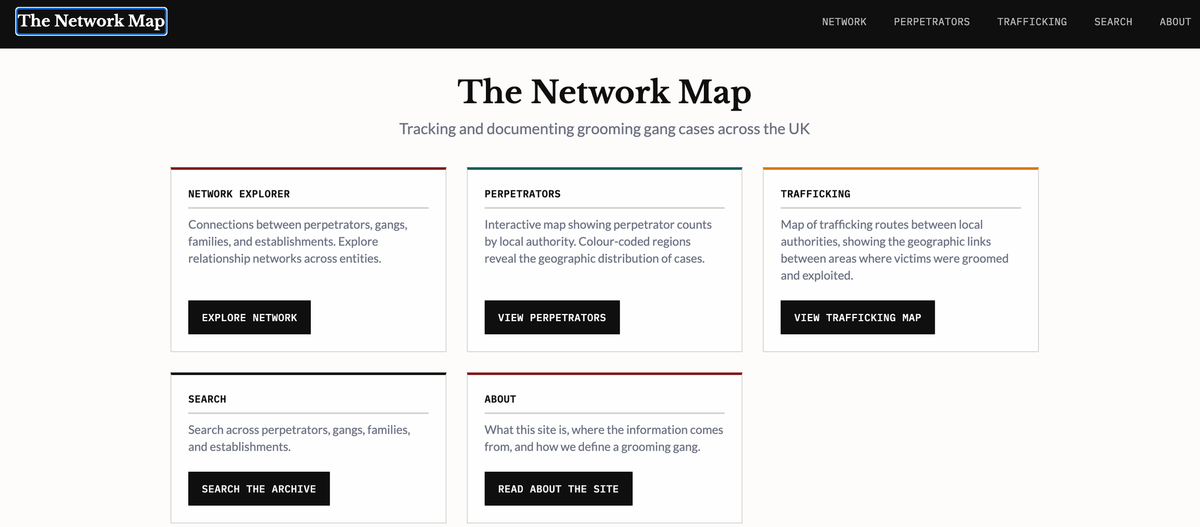
The Network Map, which went live in late August, is the resource I was looking for. It is the first attempt to piece together the patterns of child sex trafficking and rape that have gone unreported or that were badly recorded in official sources. We arranged an exclusive interview with the creators, and I began by asking them what prompted them to take up this cause.
"What prompted this was realising that the overwhelming narrative on grooming gangs was the gangs were isolated incidents, and that they are a thing of the past.
We saw a number of incidents that made us believe this was not the case. For example, just in the last five years, there have been more than 250 convictions. We have verified that at least 34 of these were actually committed in that time, and were not just prosecutions of historic offences.
Additionally, we thought it was very clear from seeing several stories on trafficking and family-based gangs, that they were almost certainly connected, not simply isolated.
Our map, though relying almost entirely on publicly sourced data, does what others have not, in that it sets out expressly to demonstrate this interconnected nature. We think the network page speaks for itself in this regard."
You've taken out a free subscription. Thanks. That's terrific. Please consider taking out a paid subscription to support our coverage over the coming year, which will include the public inquiry on grooming gangs and other nationally important local topics.
I ask what the map does not show.
"We have several other theories about involvement of certain organisations in covering up or abetting the gangs. We have spoken to insiders, but do not have access or rights to publish sufficient data on this to make those stories available."
This is one of the reasons why The Network Map is a serious body of work and why conspiracy theories such as those peddled for money by the likes of Raja Miah are not serious. The creators of The Network Map are careful not to make claims that go beyond evidence, whereas Miah only makes claims that go beyond the evidence.
When you navigate through The Network Map, you see that huge conspiracies have facilitated the rape of girls and women, and that there are many trafficking routes from places you would not normally connect. I asked how the group, who remain anonymous for security reasons, compiled the map.
"We used several methods. Much of it is simply from trawling through a large amount of articles to see if crimes have involved gangs. If they do we copy the information into our database along with the source, and add several 'codes' and extrapolate pieces of data to make them easier to search. These are then mapped. Information always comes from a source we believe to be pre-verified in some form, for example a major publication like the BBC or Guardian, and we of course do a sense check and crosscheck between sources. We have worked with a number of researchers and journalists to cross-check each entry, though we're sure there will be occasional errors."
That is another thing that distinguishes The Network Map from the conspiracy theorists. They are prepared to admit fallibility and invite corrections. If you correct Raja Miah online, he's likely to target you by encouraging a pile on from his scary right-wing followers.
The Network Map compilers are absolutely forthcoming about gaps in knowledge.
"It's hard to know what we don't know. What we do know is that there is a lag in convictions, that these crimes are significantly under-reported, and that there is significant institutional pushback against the idea of transparency...We suspect the scale is significantly larger than even we can show, and have a number of reports of active silencing of evidence that we unfortunately cannot publish."
That's a scary proposition. Perhaps state institutions such as the police, local authorities and even national politicians have overstepped their authority because of fears of racial and ethnic disharmony; perhaps they have protected child abuse networks because the problem is expensive to investigate; and perhaps they have actively protected child abusers and silenced survivors. But, The Network Map says, the evidence is not sufficient to say that.
"We hear a lot of rumours and testimony, but we want our map to be as close to unimpeachable as possible, so we do not include them."
When I asked if they can share their information log for external verification, they say they cannot for security reasons. On balance, this cautious approach is fair enough. On the one hand, right-wing groups, together with their champion Raja Miah, have no credibility in the field because they publish rumours as findings of fact. On the other, the institutions that have underplayed the extent and geographical spread of child sexual abuse and the criminal conspiracies behind it would be able to say that allegations based on rumour are evidence of incitement. Moreover, the problem is better understood from a perspective away from the mainstream, where spray-and-pray conspiracy theories are put up against equally silly outright denial. The problem deserves an empirical approach, and if that has to be done in seclusion, so be it. As the creators say: "This is all discoverable online. We just were the first to put the effort to bring it all together and highlight the connections."
Rupert Lowe, Raja Miah and others have used survivors to pursue their racist agendas against the Pakistani diaspora communities, but The Network Map approached them in a more sensitive way: "Some survivors have been in discussion with us or our associates to add colour or suggestions of where to look. Again, all of the information that we publish, with some rare exceptions, are from other platforms who already have the burden of redaction".
The Oldham Owl will be covering the national public inquiry in Oldham when it comes about. The inquiry has said that it will not comment on who is invited to give evidence in public or under what conditions, but they could do worse than to ignore peripheral figures with ulterior, financial motives such as Raja Miah, and should instead speak to people such as the creators of The Network Map, who are interested in understanding the problem, much like the public inquiry itself.
Rationalism has a foothold again.